Article: When do children's shoes fit perfectly?
When do children's shoes fit perfectly?
The studies are clear. Most children wear shoes that are either too small or too large. According to an Austrian study, two out of three children wear shoes that are too short. The consequence is as follows: 98 percent of babies have healthy feet, while among adults, this figure drops to only 40 percent. This sounds incredible, especially since children never actually complain about shoes that pinch. Why is that?
Children's feet are insensitive to pain
Children rarely say if their shoes are pinching them, because their bones are still soft and malleable. They are relatively insensitive to pressure, as their nervous system and sensitivity are still developing. The study confirms this: 90 percent of children feel comfortable even in shoes that are too short. The consequences, however, are anything but pleasant: the feet adapt to the shoe shape and deformities develop. Feet only complete their development and achieve their final shape and firmness at around 16 years of age. A large proportion of permanent damage, altered toe positions, joint inflammation, shortened muscles, and problems with the musculoskeletal system result from the developmental period in childhood. The main causes of this are too little varied movement, overweight, and inappropriate footwear.
Children's feet grow in spurts
Another problem is the growth of feet. Children's feet grow in spurts, up to three sizes per year. Even new shoes can quickly become too small again. So measure regularly, at least once every six months – and of course, without the shoe on the foot.
Shoes that are too large are also dangerous
It's not enough for the foot to just fit into the shoe – it also needs room to move. However, shoes should not be too large, otherwise the feet won't have any support in them. In shoes that are too large, children cling to the sole with their toes, or the foot slides forward and is compressed with every step. The harmful health effect is then the same as with shoes that are too small.
First measure, then select
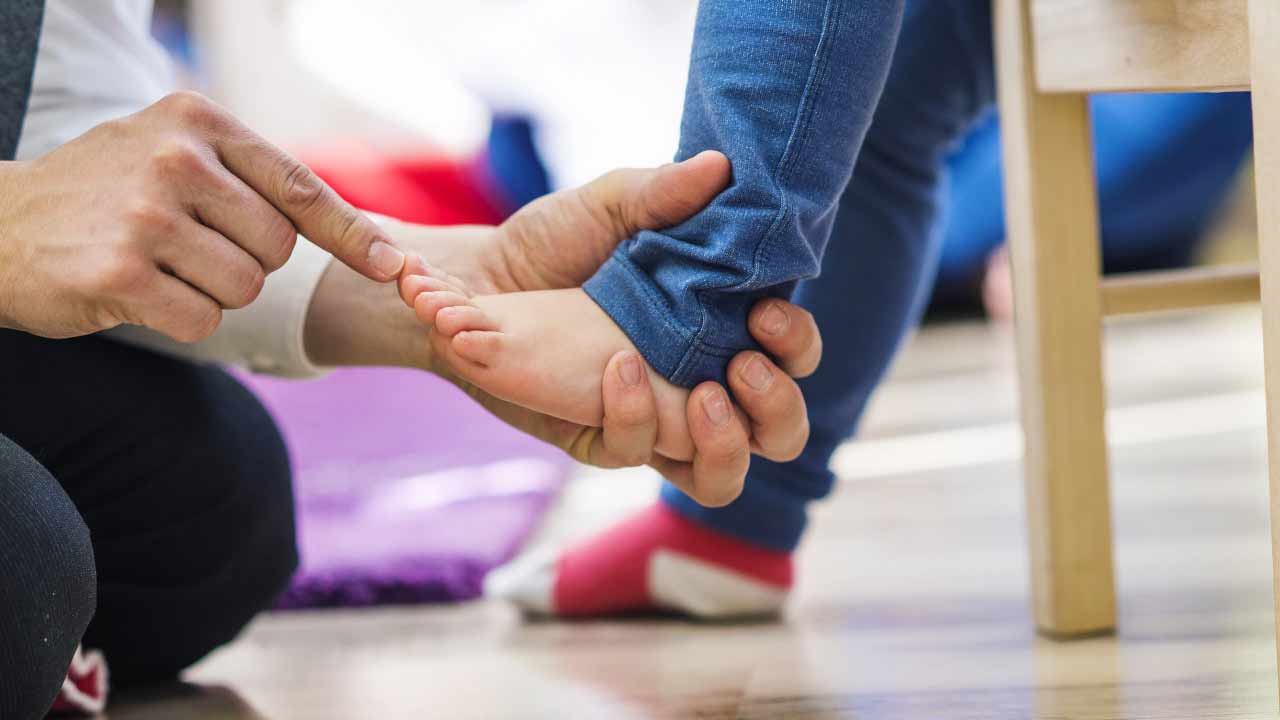
Regular measuring, and especially before every shoe purchase, is an important rule to observe for the sake of children's feet. How do you do that? For example, like this: Before buying, make a footprint on cardboard. Trace the outline of both feet with a pen. Add 12 millimeters to the longest toe (it doesn't have to be the big one). Connect the corners and cut out the template. This template must fit into the new shoe without squeezing or pushing. Shoe specialist stores usually also have special measuring devices for this purpose. So, before buying new shoes, feel free to ask about an internal measuring device, because the inner size rarely corresponds to the outer size. The popular "thumb test" rarely achieves its goal: children often reflexively pull in their big toe when adults press on the front of the foot. Then the shoe seems to fit perfectly. To ensure that the toe is not pulled in, you should simultaneously place your other hand flat on the shoe. But even then, the thumb test is nothing more than a rough guide.
How many pairs of shoes does a child need?
A single pair of shoes is not enough. Children's feet often sweat a lot. So that the shoes can dry and air out from the inside after wearing, it is important that children do not wear the same ones every day. For each season, at least two pairs of everyday shoes should be readily available and worn alternately. In addition, rubber boots and slippers are needed.